When does a solar plant pay off?
In recent years, interest in solar panels has grown noticeably in Uzbekistan — driven by regular increases in electricity tariffs, government subsidies, and programs such as “Quyoshli xonadon” (“Solar Home”). But the main question that concerns most people remains the same: when will the investment pay off and the plant start generating net profit?
There is no single answer — the payback period depends on a number of factors: the plant's capacity, the quality of the equipment used, the level of solar irradiation in the region, how the generated energy is used (for self-consumption or for sale to the grid), and government incentives.
Key Factors Affecting the Payback Period
1. Initial investment amount. Installing a 5–10 kW system for a home requires, on average, an investment of 30–70 million UZS. The higher the capacity, the greater the upfront cost, but the cost per kWh usually decreases.
2. Solar irradiation and output volume. Output volume depends on the region, panel placement, and the number of sunny days per year. Uzbekistan sees an average of about 320 sunny days per year, making the country one of the favorable regions for solar energy 1.
3. How the generated energy is used. If a system is used only for self-consumption, the benefit comes from savings on electricity bills. If surplus energy is sold to the grid, an additional source of income appears. In practice, a 10 kW plant configured solely for grid sale pays for itself in approximately 24–30 months (2–2.5 years).
4. Government subsidies and incentives. Under the “Quyoshli xonadon” program, individuals receive a subsidy for each kWh of surplus electricity fed into the grid from plants up to 50 kW (currently around 1,000 UZS per kWh). In addition, citizens who install a solar plant using their own funds are entitled to a one-time compensation (up to 20 times the base calculation value, i.e. approximately up to 6.8 million UZS). Land and property tax on the area occupied by panels is also waived for 3 years (up to 10 years for systems with batteries). In January–March 2026 alone, the population of Uzbekistan earned more than 73.9 billion UZS from selling solar energy to the grid — showing the real scale of this direction.
5. System type and equipment quality. Battery-equipped systems require more investment but increase energy independence and long-term reliability. Quality inverters and panels last longer and reduce repair costs — which positively affects overall economic
efficiency.
Real Examples: Projects of Different Scales
Below are approximate calculations for solar systems of various scales. Rows 2 and 4 are based on real figures from open sources; rows 1 and 3 are conditional (estimated) calculations built on the same data.
System Type | Capacity | Initial Investment | Annual Output | Payback Period |
|---|---|---|---|---|
Small residential system (self-consumption only) | 5 kW | ~35 mln UZS | ~7,500 kWh | ~4–5 years |
Medium residential system (grid sale + subsidy) | 10 kW | ~60–70 mln UZS | ~15,000 kWh | 24–30 months (2–2.5 years) |
Small commercial facility (shop, warehouse, small production) | 50 kW | ~250–350 mln UZS | ~75,000 kWh | ~3–4 years |
Large industrial plant — the "Nur Navoi" solar plant (Karmana district) | 100 MW | ~$110 million USD | ~252–260 mln kWh | 7–10 years (5–6 years with incentives) |
Real Example: "Nur Navoi" Solar Plant (Karmana) 2
To understand the practical performance of large solar plants in Uzbekistan, it is useful to look at the country's first major solar photovoltaic plant.
Location | Navoi Region, Karmana District |
|---|---|
Installed capacity | 100 MW |
Investment volume | ~$110 million USD |
Number of panels | ~300,000 units |
Land area | 283 hectares |
Average annual output | ~252 million kWh |
Natural gas saved | ~80 million cubic meters per year |
Investor and operator | Masdar (UAE) |
Operating term (PPA agreement) | 25 years |
Year commissioned | 2021 |
This project became the first power plant in Uzbekistan's history built by a private investor 2, and served as the “first swallow” in the development of the country's solar energy sector. Following this, the same investor is implementing several hundred more megawatts of solar plants in the Bukhara, Samarkand, and Jizzakh regions 4.
Such large-scale projects are usually built on the basis of long-term power purchase agreements (PPAs) lasting 25 years — this guarantees the investor a stable income stream over several decades and typically implies a payback horizon of 7–10 years.
The table shows that as the scale of a project increases, so does its payback period — large projects are usually built on the basis of long-term power purchase agreements (PPAs) and require significant infrastructure spending. At the same time, the ability to sell to the grid and government subsidies noticeably shorten the payback period for household systems.
Diagrams
Diagram 1. Below is a visual comparison of payback periods for solar plants of different scales — from household systems to large industrial facilities:
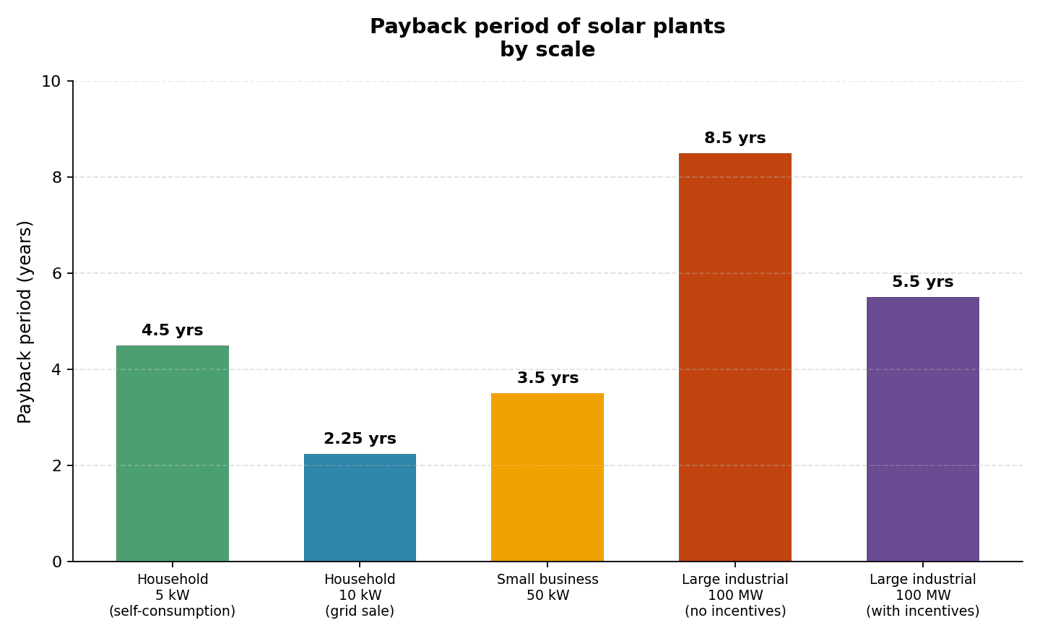
Payback period of solar plants by scale
As the diagram shows, a household system oriented toward grid sale pays for itself fastest (~2.25 years), while a large industrial project without incentives requires the longest period (~8.5 years).
Diagram 2. The following chart shows the cumulative cash flow (investment payback dynamics) of a 10 kW household plant operating in grid-sale mode, broken down by month:
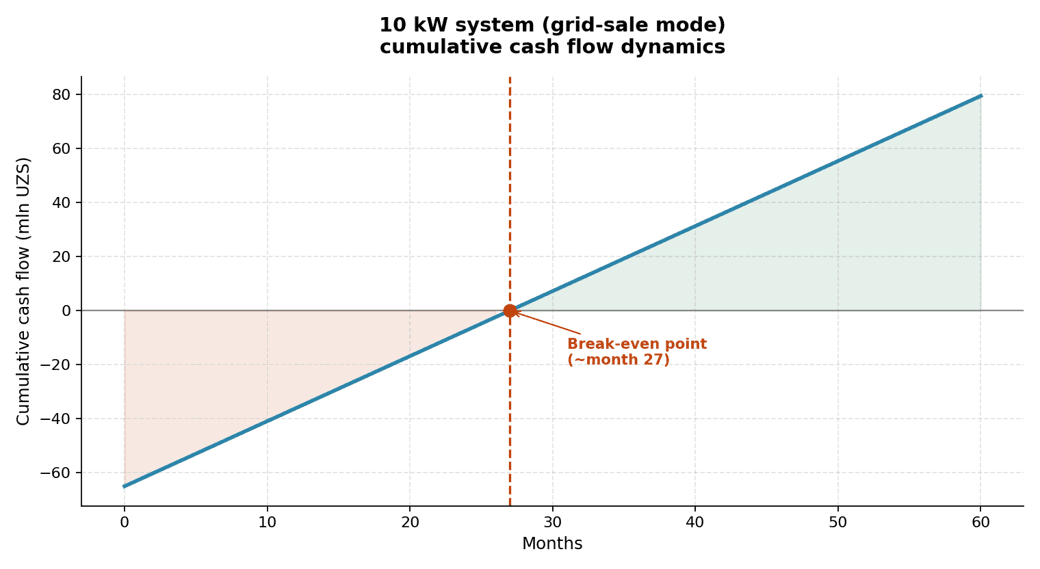
Cumulative cash flow chart for a 10 kW system
As the chart shows, in the first months the cash flow remains in negative territory (the investment has not yet paid off), reaches the zero mark at around month 27, and from that
point the system starts generating net profit.
Why This Figure Changes Year to Year
The gradual increase in electricity tariffs in Uzbekistan is strengthening the economic appeal of solar energy — as the cost of electricity purchased from the grid rises, so does the value of every kWh of solar energy saved or sold. At the same time, the government regularly updates the “green” tariff system and subsidy mechanisms — starting from 2026, the introduction of new “green tariffs” for legal entities is also being discussed — which requires the calculations to be revisited every year.
Conclusion
A solar power plant is not a one-time expense but a long-term investment. For small household systems, the payback period — especially accounting for grid sale and subsidies — is 2–3 years, while for large industrial and commercial projects this figure ranges from 5–10 years. To calculate the exact period, it is necessary to take into account: the level of solar irradiation in the region, the capacity and quality of the system, the way the energy is used (for self-consumption or sale), and the current government subsidies. An accurate preliminary calculation before investing is the most reliable way to realistically assess the expected benefit.
Sources
1. Press Service of the President of Uzbekistan — https://president.uz/oz/lists/view/4580
2. Wikipedia — Navoiy Nur QES — https://uz.wikipedia.org/wiki/Navoiy_Nur_QES
3. PRNewswire (official Masdar statement) — https://www.prnewswire.com/ru/press-releases/masdar-nachinaet-realizatsiiu-znakovogo-proekta-nur-navoi-solar-na-100-mvt-v-uzbekistane-859633694.html
4. Spot.uz — https://www.spot.uz/oz/2020/12/23/fotoelektr-stansiya/
5. World Bank Group — https://www.worldbank.org/en/news/press-release/2024/05/21/uzbekistan-to-build-new-solar-plant-and-first-battery-energy-storage-system-with-world-bank-group-support