
USA / RENEWABLE ENERGY Renewable Energy in the USA: How Solar, Wind and Innovative Technologies Are Changing the Country’s Economy
USA / RENEWABLE ENERGY
Renewable Energy in the USA: How Solar, Wind and Innovative Technologies Are Changing the Country’s Economy
___________________________________________
ANALYTICAL ARTICLE • NOVEMBER 2026
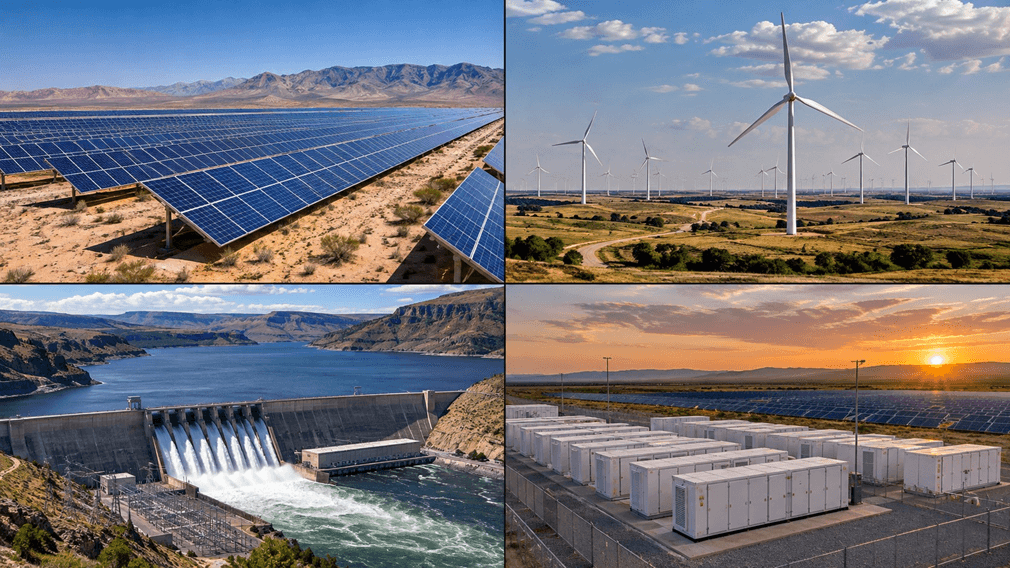
Illustrative images: solar power, wind power, hydropower and energy storage systems.
We are continuing our series of publications and reviews focused on the current state of the energy sector in various countries. Our work is centered on an analysis of the renewable energy segment, including its development dynamics and prevailing trends.
Introduction. A New Stage in the Development of US Energy
The United States of America is one of the world’s largest producers and consumers of electricity. Industry, transport, digital technologies, data centers and households create substantial demand for electricity.
In recent years, the structure of the US energy sector has been changing noticeably. Gas, coal and nuclear power plants continue to play an important role, but solar and wind power have become leading areas for the construction of new generating capacity.
According to final data from the US Energy Information Administration (EIA), the country’s utility-scale power plants generated approximately 4.43 trillion kWh of electricity in 2025. Small-scale solar installations produced an additional approximately 93 billion kWh. Renewables accounted for around 24% of utility-scale generation.
≈24% | 461.6 billion | 43.4 GW |
|---|---|---|
renewables’ share of utility-scale generation, 2025 | kWh of wind generation, 2025 | planned new solar capacity, 2026 |
EIA indicators: actual 2025 data and plans published in February 2026.
1. Key Indicators of Renewable Energy in the USA
In 2025, renewable sources supplied approximately 1.16 trillion kWh of electricity in the USA. Including both utility-scale power plants and small-scale solar installations, their combined share of electricity generation was approximately 25.6%.
Electricity generation from renewables in 2025, billion kWh
Energy source | Generation, billion kWh |
|---|---|
Solar power (utility-scale and small-scale installations) | 461.6 |
Hydropower | 393.3 |
Bioenergy | 241.3 |
Geothermal power | 45.3 |
TOTAL | 1,157.1 |
Source: EIA, Electric Power Annual, published in October 2026. Total rounded.
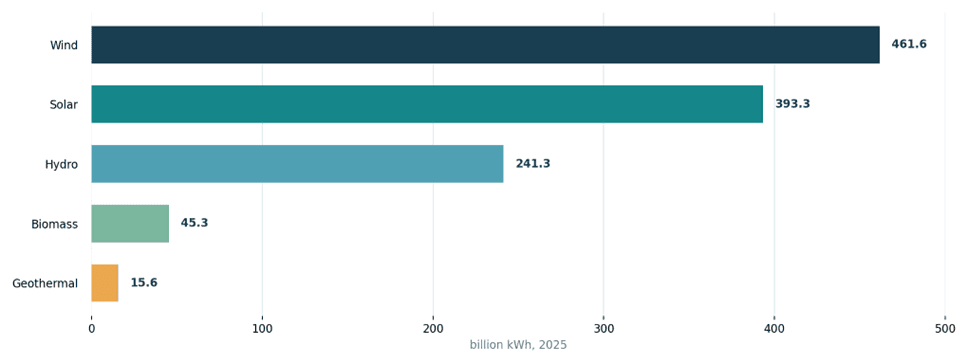
Wind power remains the largest renewable source by electricity output, while solar power is growing particularly rapidly. In March, the preliminary estimate for wind generation was approximately 464 billion kWh; the annual table revised this figure to 461.6 billion kWh.
2. Solar Power — A Center for Investment and Technology
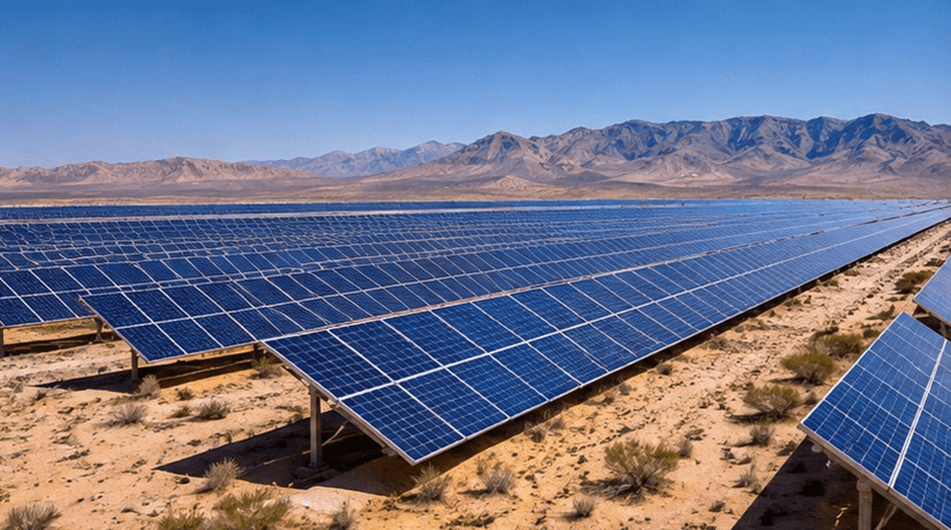
Illustration: a utility-scale solar power plant in an arid region of the USA.
The southern and western regions of the USA have favorable natural conditions for solar power. California, Texas, Arizona, Nevada and Florida are examples of states developing utility-scale photovoltaic plants, industrial solar installations and panels on residential rooftops.
In 2025, total solar electricity generation reached 393.3 billion kWh, an increase of approximately 29.5% compared with 2024. This growth is associated with the construction of new plants, the expansion of existing projects and the development of energy storage technologies.
Three main models for using solar generation have emerged in the USA:
- Utility-scale power plants sell electricity to the grid, either on the market or under long-term agreements.
- Industrial and commercial facilities install panels on their own premises to reduce electricity costs.
- Households and small businesses install rooftop panels; the ability to sell surplus electricity to the grid depends on local rules.
Once construction is complete, a solar power plant does not need to purchase fuel. However, a project’s overall economic performance depends on the cost of equipment, financing, grid connection, maintenance and the electricity selling price.
3. Wind Power — One of the USA’s Largest Resources
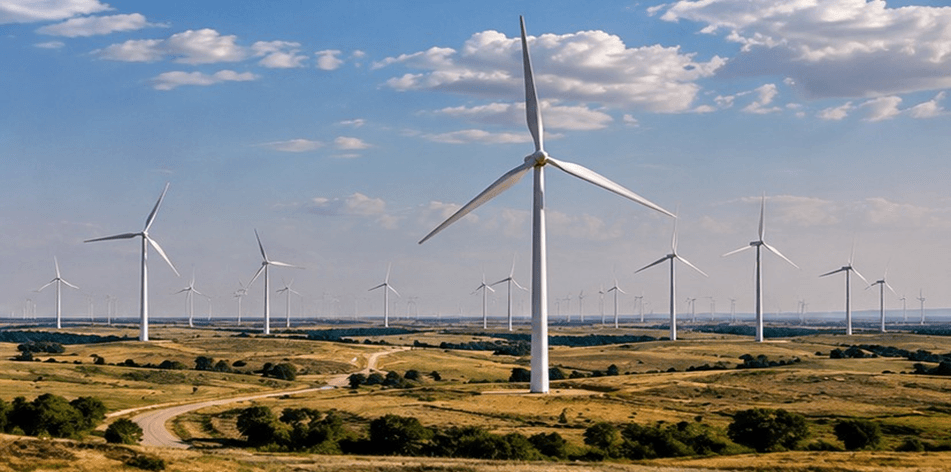
Illustration: a wind farm on the plains of the USA.
Wind power is particularly widespread in Texas, Iowa, Oklahoma, Kansas and other central states. Large open areas and consistent wind resources make it possible to build major wind farms.
In 2025, wind farms generated 461.6 billion kWh of electricity, approximately 2.1% more than in the previous year. Texas stands out for the scale of its projects and its developed energy infrastructure, while Iowa demonstrates the significant role of wind in its own power system.
Wind projects can provide landowners with lease income, create construction and operating jobs, and supply industrial consumers with electricity under long-term agreements. However, generation depends on weather conditions, so wind farms require well-developed grids, flexible capacity and energy storage systems.
4. Hydropower — A Traditional Renewable Resource
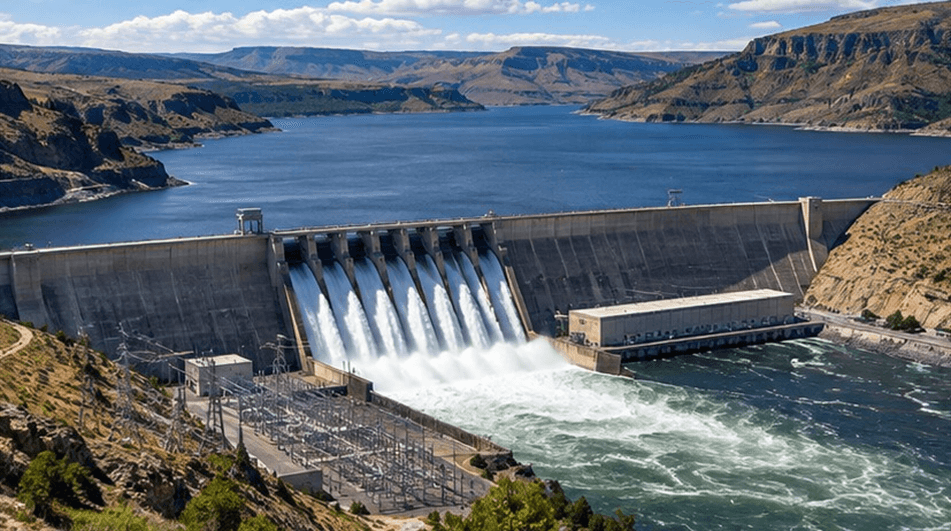
Illustration: a hydroelectric power plant and reservoir.
Hydropower has a long history in the USA. Major rivers and reservoirs in western regions account for a significant share of hydroelectric generation. Washington, Oregon and California are particularly prominent. Grand Coulee in Washington State is one of the country’s largest hydroelectric power plants.
In 2025, US hydroelectric power plants generated approximately 241.3 billion kWh of electricity. When sufficient water resources are available, hydropower allows generation to be controlled and helps balance a power system with a growing share of solar and wind generation.
The main challenges include droughts, seasonal variations in water availability, environmental requirements, and the modernization of aging equipment and infrastructure.
5. Geothermal Power and Bioenergy
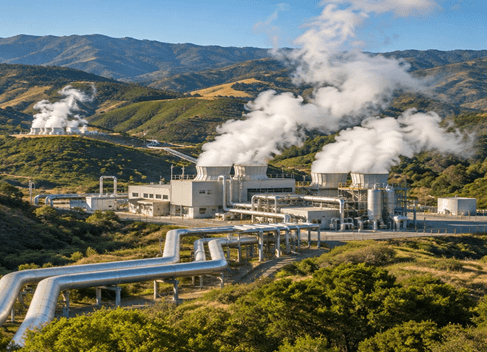
Geothermal power
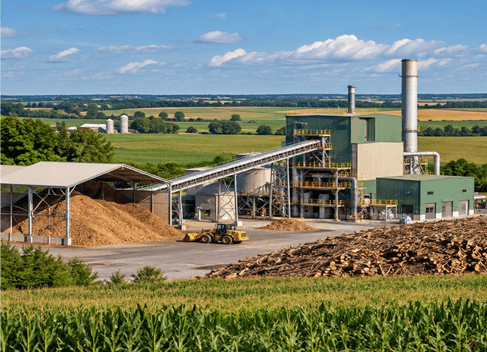
Energy production from biomass
US geothermal power is primarily developed in California and Nevada. It uses heat from within the Earth and can operate relatively independently of weather conditions. In 2025, geothermal plants generated approximately 15.6 billion kWh. The country is also developing enhanced geothermal systems (EGS), which could expand the geographical use of this resource.
Bioenergy uses wood, agricultural residues and certain types of organic and municipal waste. In 2025, electricity generation from biomass totaled approximately 45.3 billion kWh. An important advantage of this sector is converting some waste into useful energy, although feedstock transport, emissions treatment and operating costs affect project economics.
6. Energy Storage — A Key Element of Innovation
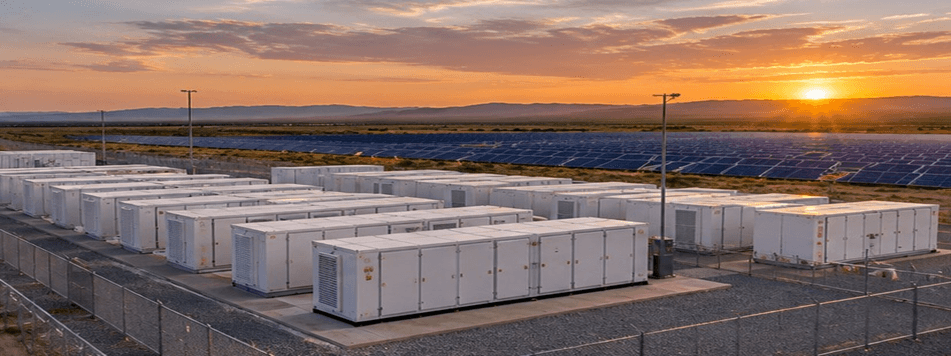
Illustration: a utility-scale battery energy storage system (BESS).
Electricity output from solar and wind power plants varies with the time of day and the weather. As a result, utility-scale battery electricity storage — Battery Energy Storage Systems (BESS) — is developing rapidly in the USA.
43.6 GW | approximately 52 GW |
|---|---|
capacity at the end of 2025 | capacity by the end of June 2026 |
The USA added a further 8.3 GW of battery capacity in the first half of 2026. Source: EIA, August 7, 2026.
Battery systems allow some solar electricity to be stored during the day and returned to the grid in the evening, when demand rises. For example, the Bellefield Solar and Energy Storage Farm in California combines 500 MW of solar generation with 500 MW of battery capacity; the relevant installations began operating in December 2025.
These solutions can be used to sell electricity during higher-price hours, smooth grid loads and increase the commercial value of solar power plants. According to EIA, by September 2026, more than 16% of newly commissioned utility-scale solar capacity was co-located with operating storage systems, compared with approximately 2% in 2017.
7. US Energy Development Plans for 2026
According to developers’ plans published by EIA in February 2026, a total of 86 GW of new utility-scale generating and battery capacity was expected to be added to the US power system during the year. Solar generation accounted for 51% of the planned additions, battery systems for 28%, wind for 14% and other sources for approximately 7%.
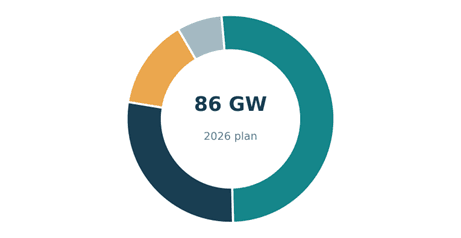
Solar power 43.4 GW |
|---|
Battery systems 24.0 GW |
Wind power 11.8 GW |
Important clarification: these are plans for 2026, not confirmation that all the listed capacity has been commissioned.
Texas is particularly prominent in solar development plans. However, final project delivery timelines depend on the availability of grid connections, financing and technological constraints.
8. The Impact of Renewable Energy on the US Economy
Renewable energy development affects not only the electricity sector, but also construction, machinery manufacturing, engineering services, equipment production, infrastructure maintenance and the financial sector.
The first area is employment. According to the US Department of Energy’s 2026 report, approximately 359,000 people worked in solar electricity generation in 2025. Employment in this segment declined by approximately 3% compared with the previous year, showing that capacity growth does not necessarily mean equally rapid growth in jobs.
The second area is reducing risks for consumers. On-site solar generation and long-term power purchase agreements (PPAs) help businesses diversify their sources of supply and manage some price risks.
The third area is investment activity. US projects involve utilities, independent power producers, banks, technology suppliers and major corporate electricity buyers.
The fourth area is innovation. Energy storage, digital control, demand forecasting and grid modernization create additional markets for services and equipment.
9. Main Challenges and Constraints
One of the most significant challenges is connecting new power plants to electricity grids. According to Lawrence Berkeley National Laboratory, at the end of 2025, generation and storage projects with a combined capacity exceeding 2,060 GW were in interconnection queues. However, a substantial share of applications is subsequently withdrawn, and far from all planned capacity will be commissioned.
Additional difficulties arise from equipment and capital costs, land approvals, environmental conditions and changes in government support. For example, federal legislation enacted in 2025 changed the deadlines and eligibility conditions for certain tax incentives for wind and solar projects.
Economic assessments of projects must therefore consider not only installed capacity, but also grid connection, storage systems, stable revenue sources, financing terms and costs throughout the facility’s operating life.
10. Which Solutions Used in the USA Are Already Being Applied in Uzbekistan
A comparison with US practice shows that Uzbekistan already uses a number of similar technical and economic solutions: utility-scale solar and wind generation, rooftop photovoltaic systems, battery storage, hydropower and long-term power purchase agreements (PPAs). However, the scale and stage of adoption of individual technologies differ. This concerns similarities in approaches rather than direct replication of American projects.
To put the scale into perspective, according to Uzbekistan’s Ministry of Energy, the country generated 86.7 billion kWh of electricity in 2025. Solar, wind and hydroelectric plants supplied 16.8 billion kWh of this total; solar and wind plants alone generated 10.5 billion kWh, 2.1 times the 2024 level. From January to August 2026, utility-scale solar and wind plants produced 9.1 billion kWh, hydroelectric plants 6.2 billion kWh, and small-scale solar panels 2.3 billion kWh.
Comparison of technologies and their actual deployment in Uzbekistan
Area | US practice | Status in Uzbekistan |
|---|---|---|
Utility-scale solar plants | Utility-scale photovoltaic facilities selling electricity to the grid | Operating solar plants and construction of new facilities; 1,413 MW of new solar capacity in 2025 |
Rooftop solar panels | Generation on homes, factories and commercial premises | More than 145,000 sites as of April 2026; total capacity of 2,114 MW |
Wind generation | Large onshore wind farms | Operating wind farms, including in Navoi Region; new facilities are being commissioned in stages |
Batteries (BESS) | Storing daytime generation and balancing the power system | Storage systems commissioned in Andijan and Fergana regions; combined solar and battery projects |
Hydropower | Large hydroelectric plants and flexible capacity | Development of existing hydropower plants and a network of small and micro hydropower plants; 64 projects totaling 41.6 MW commissioned by August 2026 |
PPA contracts | Long-term electricity sales by investors | Used in projects with private investors; an example is the 25-year PPA for a solar project in Bukhara |
Geothermal energy and biogas | Separate established commercial sectors | Research and pilot initiatives are underway; generation on a scale comparable to that of the U.S. has not yet been confirmed. |
Solar and Wind Power: Solutions Already in Operation
As in the USA, Uzbekistan is developing a model of large power plants serving a unified power system alongside small-scale rooftop generation. As of April 2026, solar panels had been installed at 33,208 business premises (1,155 MW), 88,489 households (503 MW), social-sector institutions and apartment buildings. In the first quarter of 2026, these panels generated 411 million kWh. This confirms that distributed solar power in the country already has a practical role, rather than existing solely at the planning stage. [13]
As in US states with strong wind resources, wind projects are concentrated in locations suitable for large turbines. According to official Ministry of Energy data, 752 MW of new wind capacity was commissioned during 2025. Actual generation depends on weather conditions, grid loading and plant operation. [11]
Energy Storage and PPAs: Converging Business Models
One of the most notable similarities is the use of utility-scale battery energy storage systems (BESS). In December 2024, the commissioning of storage systems with a combined capacity of 300 MW in Andijan and Fergana regions was reported. At the ceremony on December 5, 2025, a further 10 storage systems with a total capacity of 1,245 MW were listed among the new facilities. A solar facility with battery storage has also been launched in Bukhara Region. These solutions increase power-system flexibility in a manner similar to American solar-plus-storage projects. [14, 15]
In Uzbekistan, as in the USA, investment in renewables is supported by long-term power purchase agreements. For example, the World Bank describes a 25-year PPA for a 250 MW solar power plant with energy storage in Bukhara Region. This arrangement defines the obligations of the investor and the electricity buyer, facilitating long-term financing. The model is similar to US practice involving independent power producers. [17]
Hydropower and Emerging Areas
In hydropower, Uzbekistan focuses not only on modernizing large hydroelectric plants, but also on using irrigation canals and small watercourses. As of August 19, 2026, 64 small and micro hydropower projects with a combined capacity of 41.6 MW had been commissioned; the overall program envisages approximately 3,000 facilities totaling 164 MW. The difference from the US approach is the greater emphasis on distributed small plants using existing water-management infrastructure. [16]
Geothermal power and bioenergy in Uzbekistan are currently at a different stage from those in the USA. In 2025, Uzbekgeofizika JSC reported that it was preparing a feasibility study for a pilot geothermal project. A pilot technology for producing methane from biogas is being considered separately, while projects to generate energy from municipal solid waste are being implemented. These areas should therefore be described as developing, without equating plans with industrial generation already achieved. [18–20]
What the Two Countries’ Experiences Have in Common
The main shared approach combines the construction of new generating capacity with the development of grids, storage systems and contractual mechanisms. For Uzbekistan, the economic combination of a solar or wind plant, a battery, a reliable grid connection and a long-term electricity sales agreement is particularly important. It makes it possible to attract private investment and improve the predictability of energy projects. Financial performance nevertheless always depends on local tariffs, the cost of capital and the equipment’s actual operating conditions.
Conclusion
US experience shows that renewable energy development goes beyond installing solar panels and wind turbines. Solar and wind generation, hydropower, geothermal installations, bioenergy and storage are developing as interconnected elements of the energy system.
Combining electricity generation with storage is becoming particularly important. It increases system flexibility and creates new commercial opportunities. The main lesson from US experience is that the economic performance of renewables depends not only on generation volumes, but also on the coordinated operation of grids, storage systems, financing mechanisms and electricity sales.
The comparison with Uzbekistan confirms that many solutions — utility-scale solar and wind plants, distributed generation, battery storage, small hydropower and PPAs — are already being used in Central Asia as well. Geothermal and bioenergy technologies remain predominantly at the pilot-project stage. It is therefore important to distinguish commissioned capacity, investment projects under implementation and future plans when assessing progress.
Authors: F. Iminov, J. Turakulov
Sources and Links
All links below are active: click the source title in Microsoft Word.
01. EIA — Electric Power Annual, Table 1.2•https://www.eia.gov/electricity/annual/table.php?t=epa_01_02.html
02. EIA — Electric Power Annual, Indicators and Trends•https://www.eia.gov/electricity/annual/table.php?t=epa_01_01.html
03. EIA — New Capacity Planned for 2026•https://www.eia.gov/todayinenergy/detail.php?id=67205
04. EIA — Growth in Battery Storage Capacity•https://www.eia.gov/TodayinEnergy/detail.php?id=67925
05. EIA — Co-locating Solar Plants with Batteries•https://www.eia.gov/todayinEnergy/detail.php?id=68384
06. EIA — Share of Wind and Solar Generation in 2025•https://www.eia.gov/TodayinEnergy/detail.php?id=67367
07. DOE — United States Energy & Employment Report 2026•https://www.energy.gov/documents/2026-useer-national-report
08. Berkeley Lab — Queued Up, Interconnection Queues•https://emp.lbl.gov/queues
09. IRS — Limitations on Tax Incentives for Wind and Solar Facilities•https://www.irs.gov/irb/2025-36_IRB
10. CAISO/EIA — Bellefield Solar and Energy Storage Farm Data•https://askthegrid.com/assets/facilities/bellefield-solar-and-energy-storage-farm
11. Ministry of Energy of Uzbekistan — 2025 Results•https://gov.uz/uz/minenergy/news/view/127308
12. Ministry of Energy of Uzbekistan — Generation in January–August 2026•https://gov.uz/ru/minenergy/news/view/226468
13. Ministry of Energy of Uzbekistan — Panels at 145,000 Sites•https://gov.uz/ru/minenergy/news/view/156028
14. President of Uzbekistan — Commissioning of Energy Facilities and Storage in December 2024•https://www.president.uz/en/lists/view/7764
15. President of Uzbekistan — Energy Facilities and Storage in December 2025•https://www.president.uz/en/lists/view/8744
16. President of Uzbekistan — Small and Micro Hydropower Plants, August 2026•https://president.uz/en/lists/view/9513
17. World Bank — Bukhara Solar Plant, BESS and a 25-Year PPA•https://www.worldbank.org/en/news/press-release/2024/05/21/uzbekistan-to-build-new-solar-plant-and-first-battery-energy-storage-system-with-world-bank-group-support
18. Uzbekgeofizika — Preparation of a Pilot Geothermal Project•https://uzbekgeofizika.uz/ru/news/httpsuzbekgeofizikauzadminpostssavenews1421
19. Ministry of Ecology — Pilot Technology for Biogas Production•https://gov.uz/ru/eco/news/view/63708
20. President of Uzbekistan — Waste-to-Energy Projects•https://www.president.uz/ru/lists/view/9597
Original article date: November 5, 2026. The section on practices in Uzbekistan was added on November 11, 2026. Figures for 2025 are annual statistics; 2026 data cover the specified reporting periods. Images in this document are illustrative.