
Power Purchase Agreements: The Energy of the Future
Introduction
In the context of the global transition towards sustainable development and the reduction of greenhouse gas emissions, mechanisms that enable companies to directly utilize renewable energy sources are gaining increasing importance. One of the most effective tools today is the Power Purchase Agreement (PPA). Such agreements provide businesses with the opportunity not only to reduce costs and ensure predictable tariffs but also to strengthen their reputation as responsible market participants, aligned with international environmental standards.
What is a PPA
Power Purchase Agreement (PPA) is a long-term electricity purchase and sale contract concluded directly between a producer and a consumer. Such contracts can be either physical (with energy delivery) or financial (virtual), allowing companies to purchase renewable energy directly from generators at a fixed price. PPAs have become a key instrument for businesses striving to reduce their carbon footprint and achieve long-term price stability.
Corporate PPAs in the International Market
In recent years, corporate PPAs have been rapidly expanding worldwide, following the growing demand for green energy from businesses. In 2023 alone, companies signed record agreements for 46 GW1 of new renewable capacity (solar and wind), representing a 12% increase compared to the previous year. For comparison, this accounts for about 9.7% of all new global generation added in the year.
Europe has seen particularly strong growth: the volume of new corporate PPAs in the region reached 15.4 GW in 2023, up 74% from 20222. In terms of growth rates, Europe has even surpassed the United States, which nevertheless remains the largest corporate PPA market in absolute terms — with 17.3 GW of announced deals in 20233.
The largest buyers of renewable energy are technology and industrial corporations. Amazon has remained the leader for the fourth consecutive year, announcing
purchases of 8.8 GW of clean energy capacity through PPAs in 2023 alone. The active involvement of multinational corporations is directly linked to their
global sustainability commitments: under the RE100 initiative, more than 420 companies (including Apple, Samsung, Adobe, and others) have pledged to fully
meet their energy needs with renewables, with around 31% achieving this through bilateral PPAs.
According to forecasts by the International Energy Agency (IEA), by 2030 corporate PPAs will become the second most important driver of renewable energy development after competitive auctions, providing a significant share of new renewable capacity additions in several European countries. For industry, such contracts
are particularly attractive as they allow companies to lock in electricity prices over the long term and hedge against price fluctuations and tariff changes.
Types of Corporate PPAs
In international practice, several models of corporate PPAs have emerged, differing in the method of energy supply and payment arrangements:
1. On-site PPA (direct connection)
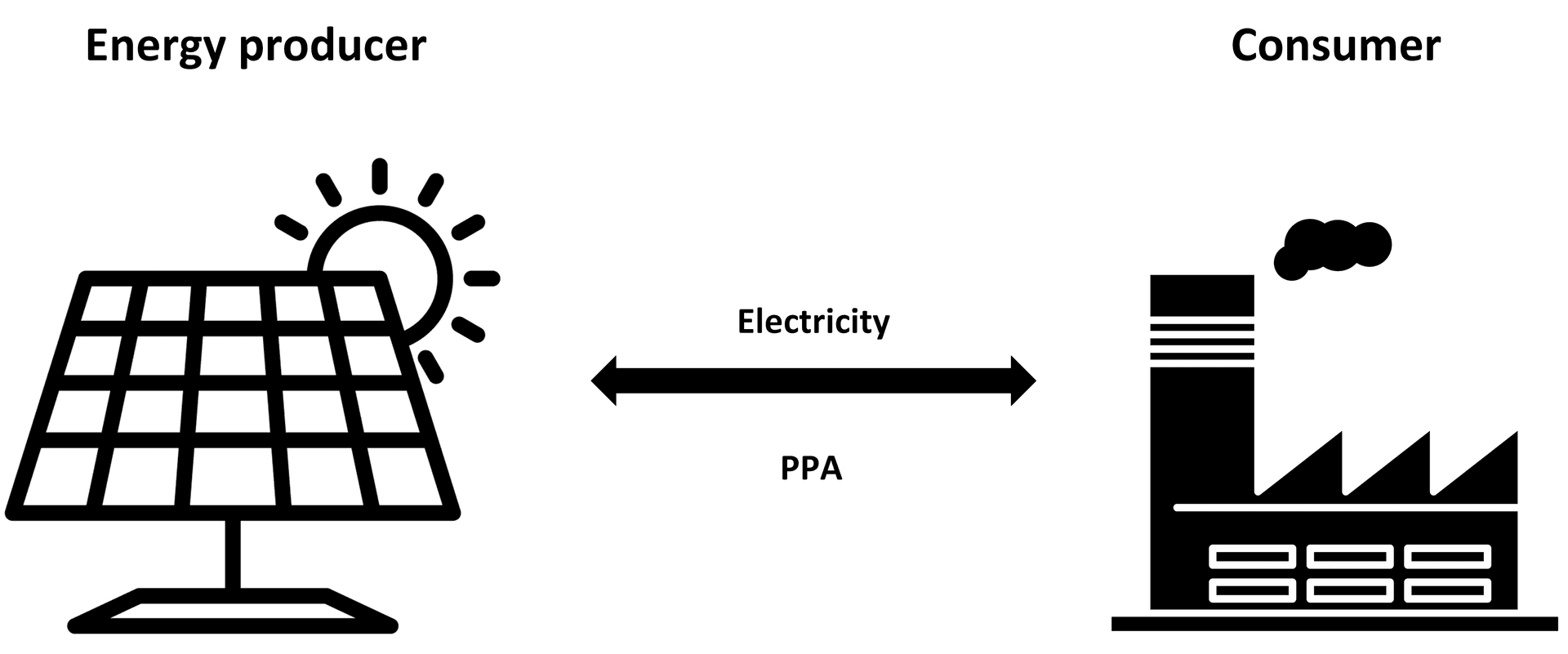
A renewable energy producer installs, for example, a solar power plant directly on the consumer’s premises. The generating facility (e.g., a rooftop solar installation) upplies electricity directly into the consumer’s grid. This type of contract allows companies to reduce their reliance on the public grid by consuming their own generation. On-site PPAs are usually signed to cover part of a company’s energy needs, while any surplus can be exported to the grid. As a result, the consumer partly avoids network tariffs, though this method requires sufficient space for the installation.
2. Off-site PPA (via network)
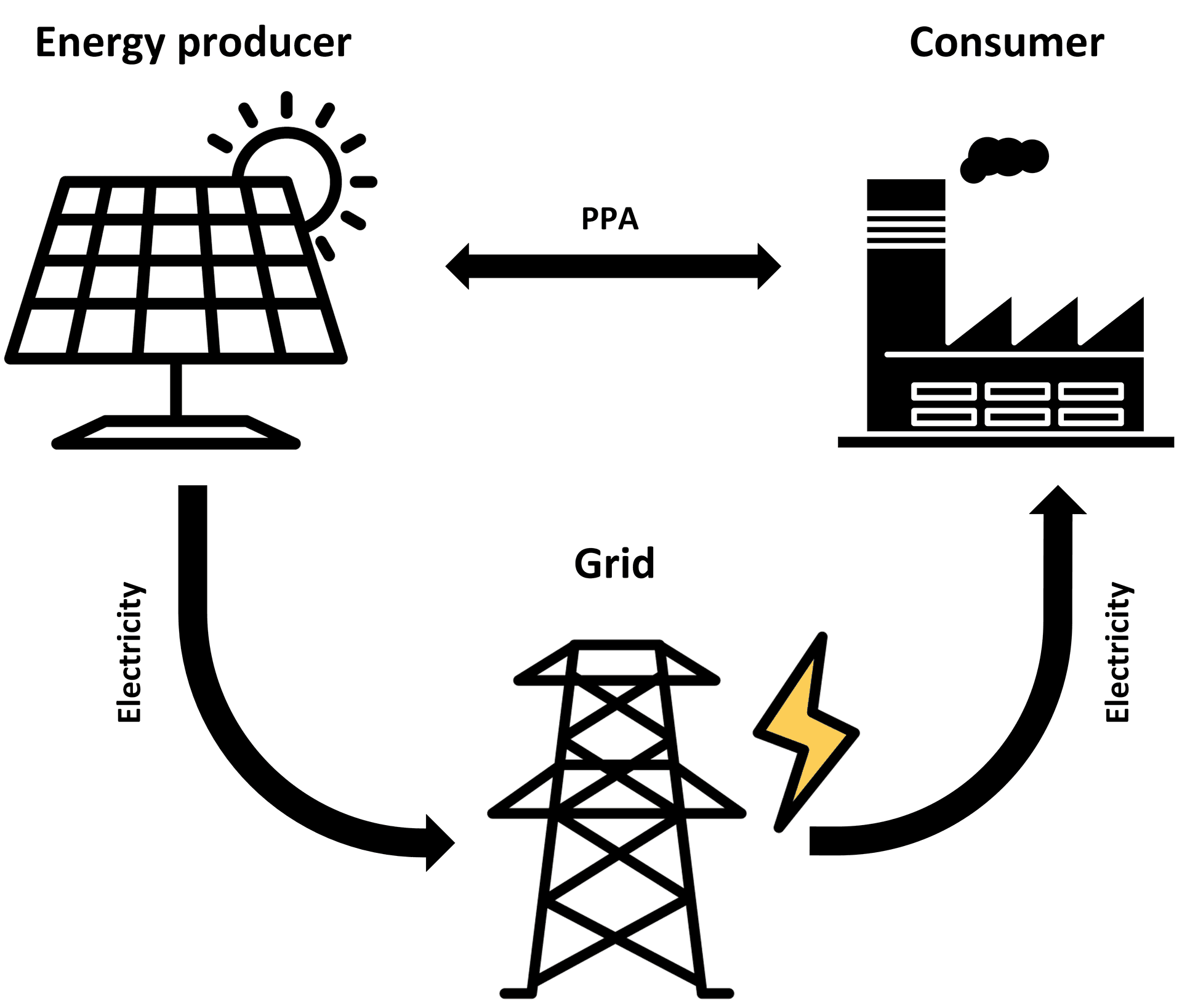
Renewable electricity is generated remotely from the consumer, at a separate power facility, and delivered through the public grid. This type of PPA requires the use of grid infrastructure (with transmission fees – wheeling), but the electricity is physically supplied from a designated facility to a specific corporate customer. In some cases, tripartite agreements are concluded with an energy supplier, which takes responsibility for delivery and balancing (so-called sleeved PPAs). Off-site PPAs allow companies to secure the required volume of renewable energy without hosting generation on theirpremises. However, their implementation requires coordination with the system operator.
3. Virtual (financial) PPA
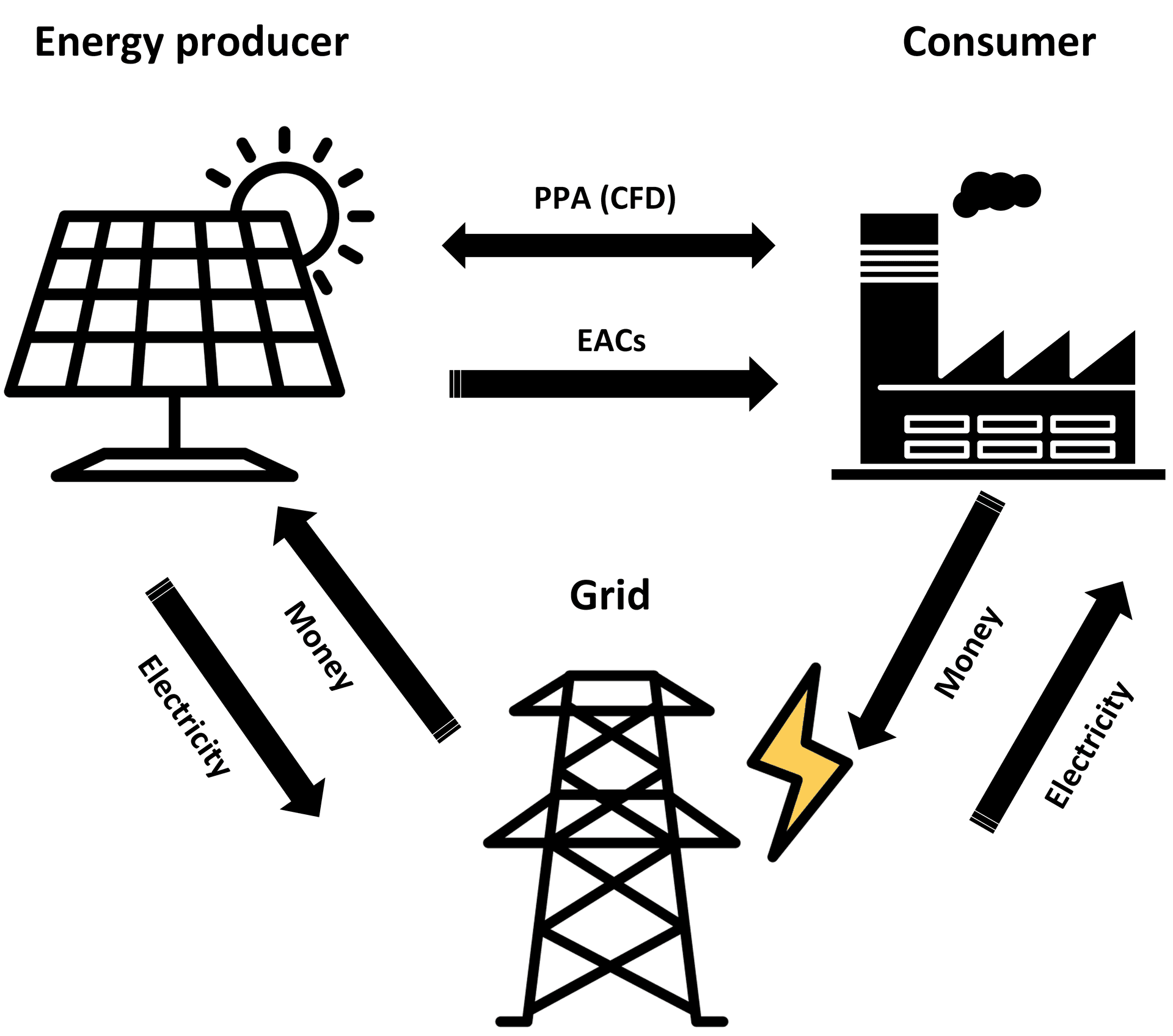
The main feature of a virtual PPA is the absence of physical electricity delivery. The producer sells the electricity on the wholesale market, while the corporate buyer compensates for the difference between the market price and the pre-agreed PPA price. In essence, a virtual PPA is a contract-for-difference (CFD) tied to a specific green project. The consumer may also obtain renewable energy certificates (e.g., I-REC) for the corresponding volume to verify their use of green energy. This model allows companies to purchase renewable energy without complex technical solutions. However, it carries risks that depend directly on market price volatility.
Conclusion
Thus, PPAs are becoming one of the key tools in the transition to sustainable energy. They enable companies not only to secure long-term electricity prices and mitigate risks related to tariff fluctuations but also to significantly reduce their carbon footprint, thereby enhancing corporate environmental responsibility. The rapid growth of corporate PPAs in the global market confirms that this mechanism will play an increasingly important role in the global energy transition. For countries aiming to expand renewable energy, the adoption of various PPA models opens new opportunities to attract investment, stimulate innovation, and strengthen energy independence.
Sources:
- BloombergNEF
- Ren21
- Renewables 2024. Analysis and forecast to 2030